


A customer taps a phone, a vendor confirms a payment, and business carries on. Across the Caribbean, digital wallets and mobile payments are giving small enterprises new ways to serve customers, while keeping the personal, community-centred spirit of doing business close to home.
The shift is visible in Jamaica, where digital wallets and Jamaica’s central bank digital currency, Jam-Dex, are helping more people pay and transfer money electronically. But it is not a story of cash disappearing overnight. Across the region, cash still plays a major role. The exciting story is that Caribbean-owned businesses have more tools than ever to make digital payments part of everyday commerce.
A NEW WAY TO DO BUSINESS
For a small shop, market stall or growing service business, accepting digital payments can make a sale easier for customers who do not carry cash. It can also help a business keep a clearer record of transactions and reach people shopping online or from another location.
That convenience matters in a region where customers, merchants and family members may be spread across islands and countries. A phone can become a wallet, a way to pay bills, or a channel for sending money to someone who needs it. The right digital option can help everyday transactions fit more smoothly into people’s lives.
The entrepreneurs behind these businesses are worth watching closely. Our feature on Caribbean entrepreneurs reshaping the diaspora economy and our conversation with the banker ladies transforming community banking in Canada tell parallel stories of enterprise rooted in community, the same spirit behind the shift to cashless commerce.
In Jamaica, Jam-Dex, the Bank of Jamaica’s retail central bank digital currency, reached 320,000 subscribers and recorded J$51.7 million in transaction value in the seven months through July 2026, according to reporting on the Bank of Jamaica’s update.
The numbers offer a snapshot of growing interest. They also point to the work still ahead: making digital payment options easy for businesses to accept and practical for customers to use.
WALLETS THAT FIT EVERYDAY LIFE
Jamaica’s Lynk wallet, operated by NCB, has around 300,000 users and is integrated with Jam-Dex. NCB has also been rolling out “tap on phone” payments for small merchants, giving businesses another way to accept contactless payments without relying only on traditional card-terminal setups.
Lynk’s features show how digital financial services can bring several routine tasks together. The wallet supports payments and transfers, and its virtual card launch expanded the ways users can pay in-store and online. NCB says Lynk also supports bill payments, mobile top-ups, local bank transfers and receiving remittances through Western Union and MoneyGram.
For Caribbean families with relatives abroad, those options matter. Sending support home is about more than moving money: it is a practical expression of care across distance, and services like JN Money Transfer have long been part of that connection. Digital services can help make the receiving end of that support more convenient, though the available methods depend on the provider, the recipient and local access.
THE BUSINESS CASE IS CLEAR
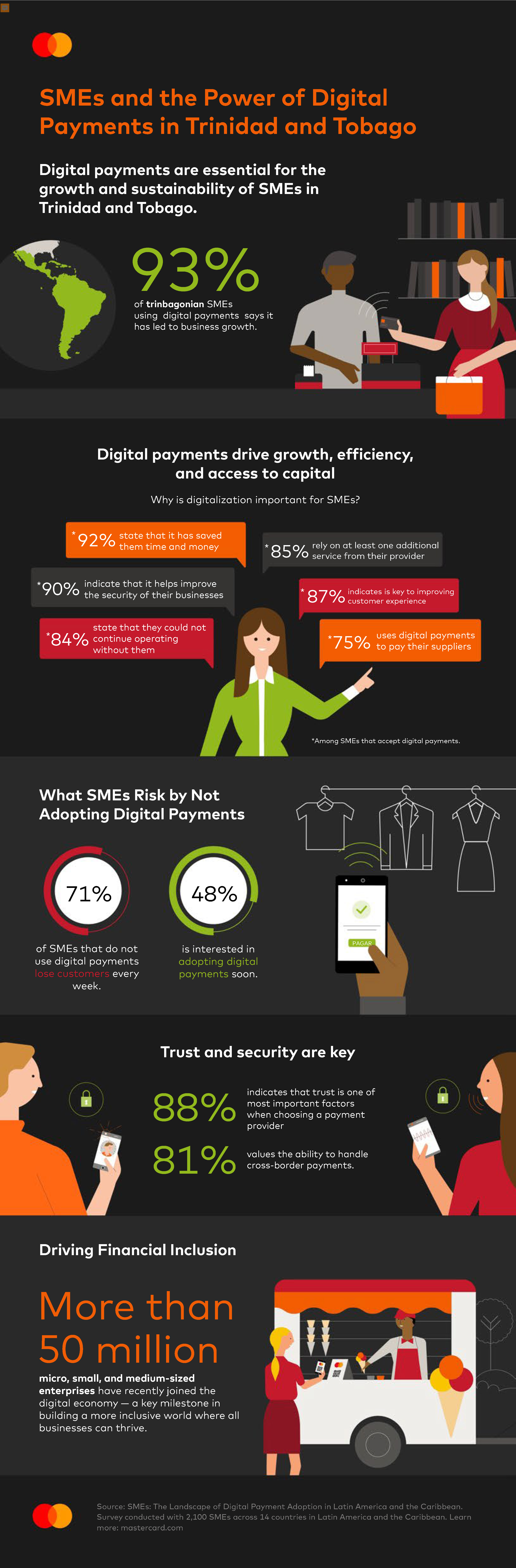
Digital payments are not just a customer convenience. A Mastercard study published in 2026 surveyed 150 small and medium-sized business owners and directors in Trinidad and Tobago. Among businesses already accepting digital payments, 93% said they were essential or very important to success, 92% said they saved time and money, and 84% said they would not stay in business if they could no longer accept them.
Those findings are specific to the surveyed businesses, not a measure of every Caribbean enterprise. Still, they show why more owners are paying attention. When digital payments help customers complete a purchase, streamline routine transactions or support payments to suppliers, they become part of how a business operates and plans for growth.
For a small enterprise, every improvement counts. A quicker checkout, a payment record that is easier to review, or the ability to serve someone shopping from a different location can make a meaningful difference. Digital adoption does not replace the welcome, skill and personal connection that make Caribbean businesses special. It gives those businesses more ways to deliver them, whether that is a soul food kitchen in Toronto or a vendor stall in Kingston. Our coverage of Miss T’s Kitchen in Ocho Rios shows the same blend of hospitality and enterprise that carries across the region.
A BIG OPPORTUNITY STILL AHEAD
The region’s progress comes with a clear gap. In August 2026, Barbados Today reported that only about 4–5% of Caribbean business transactions were conducted digitally. That figure is a reminder that adoption remains uneven, even as customers increasingly engage with businesses online and digital tools become more familiar.
For Caribbean-owned businesses, that gap represents opportunity. More merchants accepting suitable digital options can make it easier for customers to choose how they pay. Wider adoption can also support more connected commerce, particularly when customers and businesses need to transact across borders. But progress depends on more than the payment app alone: access, affordability, trust, reliable connectivity and systems that work well together all matter.
The broader economic picture is shifting too. Our recent look at oil growth in Guyana, Suriname and Trinidad and Tobago explored how the region’s economy is changing, and a modern payments landscape is part of that same transformation.
Regional support is part of the picture. The Caribbean Development Bank and the Small Business Association of Barbados launched an initiative to help at least 150 micro, small and medium-sized enterprises in Barbados, Dominica, Grenada, Saint Lucia, and Saint Vincent and the Grenadines strengthen their digital capabilities. It is a welcome recognition that businesses may need practical guidance and support to turn digital ambition into everyday tools.

KEEPING THE HUMAN CONNECTION
Going digital does not mean losing the human touch. A familiar vendor can still remember a customer’s order. A family business can still build relationships one conversation at a time. The difference is that customers may have another convenient way to pay, and business owners may have more flexibility in how they serve them.
For diaspora customers, digital payments can also bring a stronger sense of connection to the businesses and communities they care about back home. When supported by available services, paying for a purchase or helping a relative receive money can feel more straightforward. Each transaction has the potential to connect people across distance and support local enterprise.
Caribbean entrepreneurs have always adapted, finding creative ways to meet changing needs while holding on to the culture, flavour and community that make their work distinctive. Digital wallets, mobile transfers and contactless payments are part of that evolving story. The opportunity now is to make the benefits accessible to more businesses and customers across the region.
Caribbean Vibrations covers the people and ideas shaping Caribbean business, culture and community. Follow along and sign up for our newsletter for more stories from across the Caribbean and its global community.


